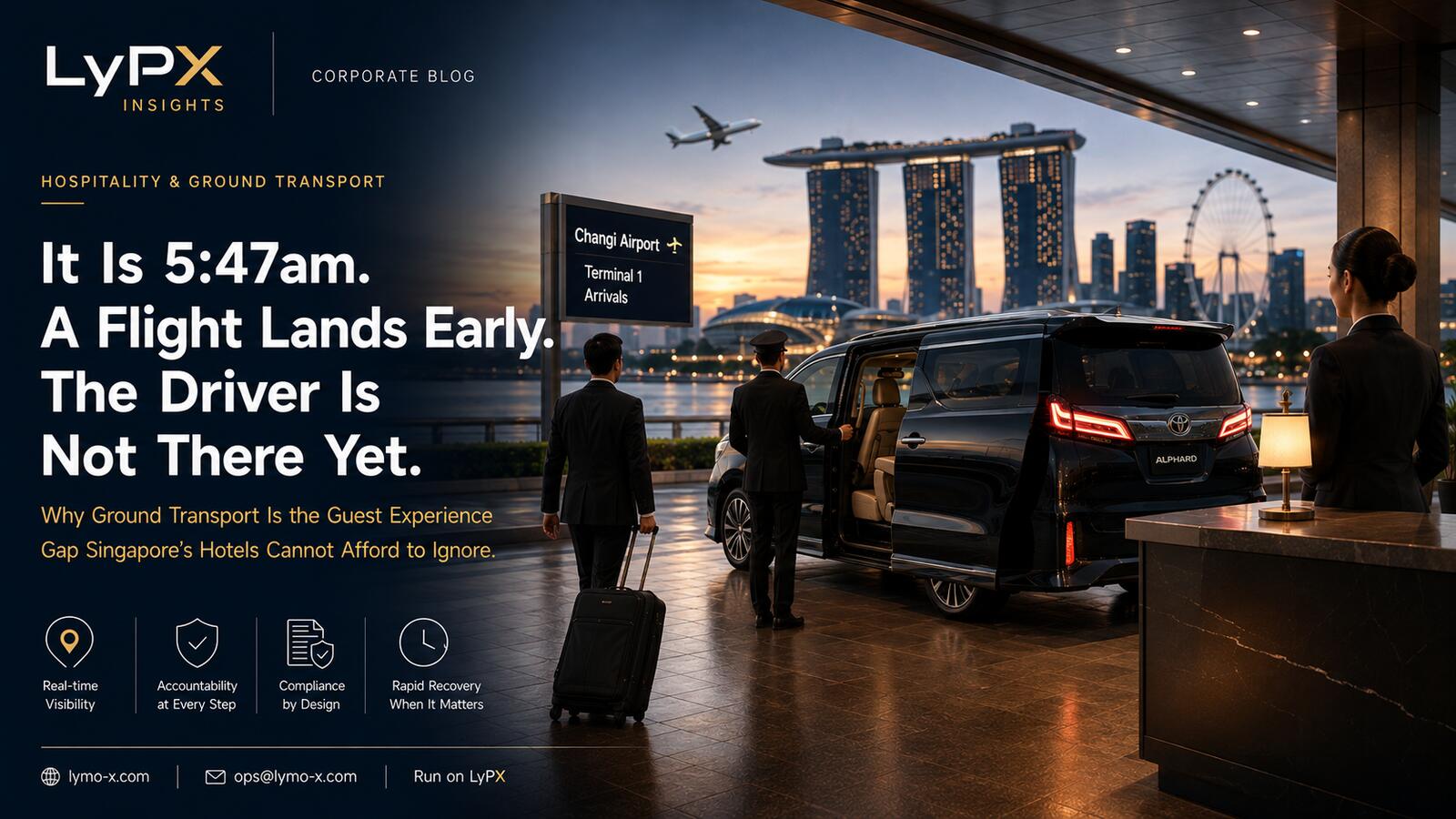
Ground transport is the first physical touchpoint a guest has with your property — before they see the lobby, before they meet the front desk team, before they taste the breakfast. It sets the emotional temperature for everything that follows. And in most hotels across Singapore, it is managed the same way it has been managed for twenty years.
This article is written for hotel GMs, front office directors, concierge managers, and DMC operators who are serious about the guest experience — and honest enough to examine the one operational gap most properties have never formally closed.
We are not starting with a product pitch. We are starting with a scenario every person in this industry has lived through.
1. The 5:47am Problem
A flight lands 40 minutes early. The driver — confirmed the night before through a WhatsApp message to a personal number — is not at the terminal. The guest is a repeat client. A top-tier loyalty member. A business traveller who chose your property over three alternatives.
The hotel finds out at 9am. From the guest’s review.
If it goes right, nobody notices. If it goes wrong, the GM hears about it — and the guest writes about it.
— LyMO Platform XThis is not a rare failure. It is a predictable one. And it is predictable precisely because the coordination infrastructure underneath the booking was never designed to prevent it — only to hope it did not happen.
A coordinator called a preferred operator. The operator WhatsApp-ed a driver. The driver confirmed on a personal number. The hotel had no visibility into whether the driver was actually en route, what vehicle was dispatched, or whether the guest details were handled correctly.
When the failure mode is identical every time, the solution is infrastructure — not better intentions.
2. What Is Coming — And Why the Stakes Are Higher Than Ever
Singapore’s hospitality sector is absorbing a significant volume expansion in the next 18 months. Each wave creates a ground transport surge that uncoordinated operations cannot handle cleanly.
Three Converging Demand Surges — All Arriving Before End 2026
Cruise — Diamond Princess and Sapphire Princess homeport simultaneously from November 2026. Hundreds of transfers in compressed two-hour disembarkation windows.
Orchard Road — Continuous programming, night-time events, and a 3,000-capacity Live Nation venue. Every event creates a post-10pm transport surge that was not in the original brief.
MICE — Singapore projecting 17–18 million international visitor arrivals in 2026. Conference delegates, corporate groups, incentive travel. Every group needs coordinated ground movement.
The hotels that absorb this volume without operational failure are not the ones with the most drivers on speed dial. They are the ones with coordination infrastructure that gives them visibility, accountability, and the ability to respond in real time when something changes.
3. The Five Guest Experience Moments Ground Transport Owns
Hotel leadership often frames guest experience around F&B, rooms, and service training. Ground transport is rarely in that conversation — despite touching the guest at five of the most emotionally charged moments in their stay.
- Arrival — The first impression. A seamless, pre-briefed, silent pickup sets the tone for everything that follows. A guest who waited, called, or had to manage logistics themselves has already started recalibrating their expectations downward.
- Departure — The last impression. A missed transfer to the airport is not just an operational failure — it is the final memory the guest carries. It is what they write about and what they tell colleagues.
- In-city movement — Restaurant reservations, business meetings, evening events. When the hotel coordinates these seamlessly, the guest experiences the property as a full-service partner, not just a place to sleep.
- Group movement — MICE and incentive groups require coordinated multi-vehicle dispatch. One vehicle arriving late cascades through the entire programme. There is no recovery that feels invisible to the group.
- Emergency response — Flight changes, medical appointments, unexpected departures. When a guest needs transport immediately and the coordinator has real-time driver visibility, the response is seamless. When they are scrolling through a WhatsApp thread, it is not.
4. What Coordinated Ground Transport Infrastructure Delivers
The shift from informal to coordinated ground transport is not a technology upgrade. It is an operations decision. Here is what it changes across the four dimensions that matter most to hospitality leadership.
Visibility
Every confirmed transfer on one dashboard. Live driver status. No chasing coordinators across WhatsApp threads. When a guest calls the front desk asking where their car is, the answer is on screen — not buried in a message thread.
Accountability
A clear chain of responsibility from booking to completion. Every job timestamped, every status logged, every driver assignment recorded. When something goes wrong, the audit trail tells you exactly what happened and when.
Compliance
Operator drivers and vehicles verified against licence and insurance records before they touch a guest. Insurance current. Licence valid. Incident protocol documented. No surprises in a tender review or a client due diligence request.
Recovery
When a job changes — flight delayed, guest added a stop, event ran late — the rebooking flows through the platform. The driver gets the update. The hotel sees the new status. The guest experiences seamlessness.
5. The Compliance Dimension Hotels Are Missing
Beyond guest experience, ground transport carries a compliance dimension that most hotel procurement teams have not formally addressed.
Every trip involving a guest is a personal data handling event. The guest’s name, arrival time, destination, and travel pattern are personal data governed by Singapore’s PDPA. When that data lives in a WhatsApp thread on a coordinator’s personal device — and is forwarded to a driver’s personal number — the hotel’s data governance posture is exposed.
The hotel’s liability does not end at the lobby door. It extends to every service provider who touches guest data on the property’s behalf.
— LyMO Platform XStructured ground transport platforms handle this correctly by design. Job records are access-controlled, with retention governed by policy rather than by whoever last held the thread. The audit trail exists not just for operational review — but for regulatory compliance if a data incident is ever raised.
For properties serving HNWI guests, corporate accounts, or government delegations, this is not a theoretical risk. It is a material one.
6. What the Decision Looks Like in Practice
Hotels that have moved to structured ground transport coordination report the same pattern: the decision feels large before it is made, and straightforward after.
The transition does not require replacing existing operator relationships. It requires putting a structured platform underneath them — so that every job those operators run on behalf of the hotel is visible, accountable, and documented.
The operators who matter to your property are already capable of running at this standard. They simply need a platform that makes that standard the default — not the exception.
At LyPX, we built the coordination layer for exactly this context. Hotels, DMCs, and hospitality operators who are serious about what happens between the booking and the destination.
The first step is always the same: knowing exactly what is broken before you build the fix.
The guest does not experience your coordination infrastructure. They experience what it enables — a driver who was there, a vehicle that matched the booking, a journey that required no interaction from them at all.
That experience is what they remember. That experience is what they return for. And that experience is only possible when the coordination layer underneath it is built to deliver it consistently — not just when nothing goes wrong. 🌐
Planning for the 2026–2027 Season?
We work with hotels, DMCs, event companies, cruise agencies, and corporate travel operators across Singapore. The first conversation costs nothing. The coordination gap costs more than most properties realise.
One honest question before you close this article:
What is the single biggest ground transport failure your property has experienced in the last 12 months — and how did you find out about it?
If the honest answer is “from the guest, after the fact” — that is exactly where LyPX begins.
References & Sources
All data and claims are drawn from official government and verified industry sources. Last accessed August 2026.
| # | Source | Title / Description | URL |
|---|---|---|---|
| 1 | Singapore Tourism Board (Official) | Princess Cruises Deepens Strategic Commitment to Singapore with Three-Year Multi-Ship Deployment | stb.gov.sg/…/princess-cruises-deepens-strategic-commitment |
| 2 | Ministry of Trade & Industry (Official) | Speech by Minister Grace Fu at Tourism Industry Conference 2026 — Orchard Road Rejuvenation Initiative | mti.gov.sg/newsroom/…/tourism-industry-conference-2026 |
| 3 | TTG Asia | Singapore refreshes Orchard Road, Sentosa precincts — night-time programming and pop-up spaces | ttgasia.com/2026/05/11/singapore-refreshes-orchard-road-sentosa-precincts |
| 4 | Global Asia Printings / Coherent Market Insights | Singapore MICE Market USD 5.25 billion in 2026, projected USD 9.85 billion by 2033 | globalasiaprinting.com/singapore-mice-market-2026 |
| 5 | Personal Data Protection Commission (Official) | Singapore PDPA Guidelines on Data Protection Obligations for Service Providers | pdpc.gov.sg/overview-of-pdpa/the-legislation/personal-data-protection-act |
| 6 | Maritime Executive | Singapore Secures Three-Year Multi-Ship Homeport Deal with Princess Cruises | maritime-executive.com/article/singapore-secures-three-year-multi-ship-homeport-deal |
All sources are publicly available and verified as of August 2026. LyPX makes no claim of affiliation with STB, Princess Cruises, Live Nation, MAS, or any referenced organisation.